
Rooted in the ancient dialogue between earth and flame, Earth & Fire: Five Voices in Clay brings together five distinct artistic voices. Each artist transforms clay into vessels, sculptural forms, and material narratives that reflect personal, cultural, and contemporary perspectives. From refined craftsmanship to experimental surfaces and bold sculptural gestures, the works reveal the versatility and enduring relevance of ceramics as an art form. Featuring work by Robert Cooper, Steve Dixon, Akiko Hirai, Walter Keeler and Chris Keenan, the exhibition offers a fantastic opportunity to acquire works by some of the most respected ceramicists working in the UK today.
The show runs in the gallery and online until 30 April.
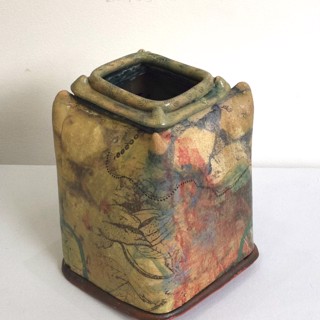
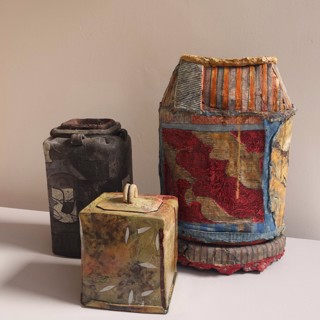
Robert Cooper is fascinated by the persistence of artefacts and ideas. Historical objects spark ideas, and Cooper is interested in the juxtaposition of contemporary ideas with the past, updating, upcycling and acknowledging storytelling through surface pattern, surfaces and imagery. In his new series of jars, surfaces are built up using a collage approach, including transfers, imprints of textiles and found objects, glazes and enamels. Of this magpie approach to making, Cooper says: "Colour, texture and mark making come together to evolve a personal take on modern living. I give clues to questions of function and contemporary issues, but, in all, I respond in the moment to what clay can give and the ideas that surface".
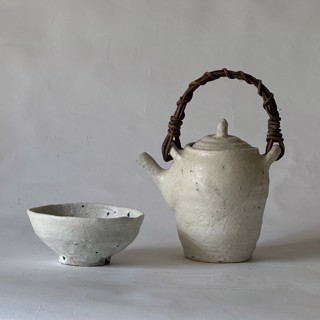
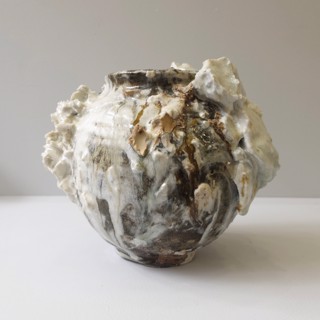
Akiko Hirai makes sculptural ceramics and practicalware using the Japanese tradition of allowing the clay itself to show the way in which it wants to be fired. By focusing on the interaction between object and viewer, Hirai’s work allows the beholder to discover the language of the objects in their own way. Hirai was born in Shizuoka in Japan and moved to London in 1999, studying ceramics at the University of Westminster and Central St. Martins. Hirai’s Moon Jars are influenced by the Korean examples of the 17th and 18th centuries. Her desire to make them has to do with their innate imperfection and balance within their environment. The imperfection of her Moon Jars is purposeful; she believes that when we see something imperfect or unfinished, our eyes try to make it into a perfect form, and as a result, our imagination is engaged. Rather than trying to control the material, she works in the mode of the Japanese concept of wabi-sabi, allowing space for spontanaeity.This is reflected in her vessels, whose organic, asymmetric forms reflect both Japanese and British studio pottery traditions.
Akiko Hirai's work is held in public and private collections across the globe, including the Victoria and Albert Museum, London, and the Hepworth Wakefield Collection. She was shortlisted for the LOEWE Foundation Craft Prize in 2019.
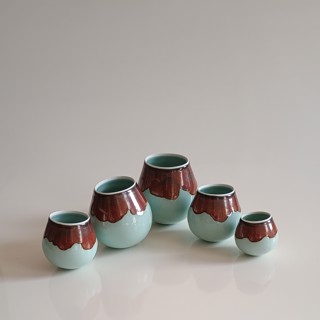
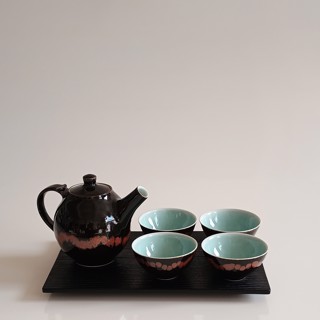
Chris Keenan has made the seductive combination of mirror black tenmokus breaking to rust and luminous celadons his signature. Made to be used, handled and lived with, his pieces explore and refine form through the use of repetition. Chris began working with clay in his mid-thirties when he began a two year apprenticeship with Edmund de Waal. His collection includes beakers, bowls, cups, teapots, jugs and pots for flowers. He likes rows, exulting in the rhythm of repeated but subtly different shapes, which emphasise the organic nature of the handmade. Chris' work has been exhibited in the UK & internationally since 1998.
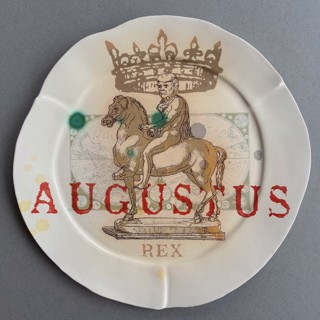
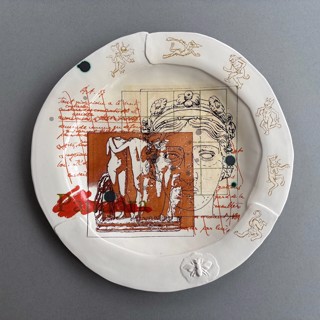
All of Steve Dixon's works are hand-built in white earthenware with a maiolica glaze, employing layering and collaging of transfer-printed imagery to reflect on the social and political issues of our times. Early exhibitions in London with Contemporary Applied Arts and the Crafts Council established a reputation for ceramics with biting political and social satire. In his latest series, Dixon directs his gaze towards the widening gulf between powerful elites and the rest of the world, using found images to draw parallels between the ancient past and the injustices of the modern world. Images and themes are widely sourced from classical mythology, biblical narratives and renaissance allegories, and processed through drawing and print using a Ricoh digital ceramic transfer printer.In this plate, Donald Trump is depicted as the Roman Emperor Augustus, who was responsible for replacing the Roman Republic with an authoritarian dictatorship.
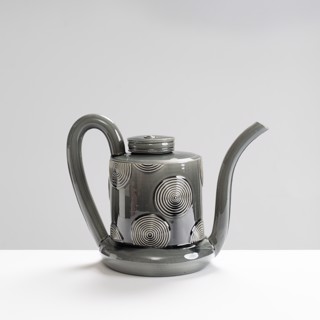
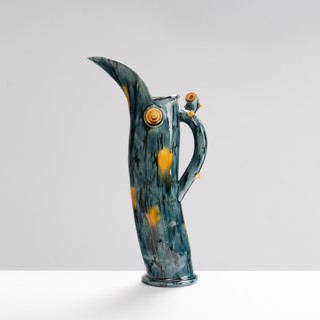
Walter Keeler has gained an international reputation for his salt-glazed ceramics, which reflect both his deep knowledge of British ceramics history and his appreciation for the sensorial delights of clay as a medium.
Walter Keeler is a British studio potter and was professor of Ceramics at the University of the West of England from 1994 to 2002. Keeler was born in London and attended Harrow School of Art, London, from 1958 until 1963 where he was trained by Michael Casson. He established his first pottery at Bledlow Bridge, Buckinghamshire in 1965, and in 1976 he moved his studio to Penallt, Wales, where he lives with his wife Madoline. Writer Oliver Watson described him as 'one of the most important and influential potters of the 1980s'. Keeler's work is held in a number of public collections including Victoria & Albert Museum, National Museum Wales, American Craft Museum, New York, Los Angeles County Museum of Art, Museum of Fine Arts, Houston, USA and the Museum of Modern Art, Tokyo.