
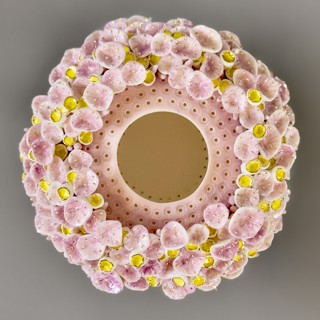
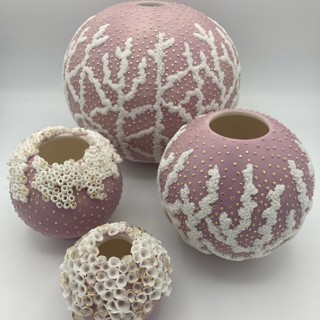
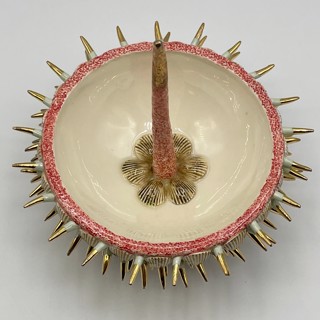
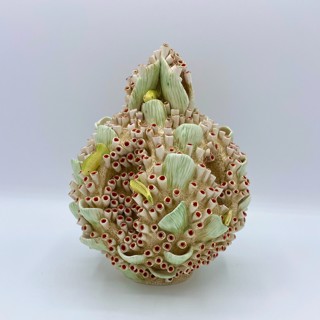
At the heart of Emmanuel’s work is an enduring captivation with marine life—particularly coral formations, sea anemones, and the remarkable variety of porous sponges that inhabit the seabed. Their flowing structures, organic patterns, and apparent fragility provide a visual language that she translates into exquisitely crafted ceramic vessels and sculptural forms. Through hand-building techniques, she creates surfaces that evoke the texture and movement of living organisms, celebrating both their beauty and vulnerability.
Emmanuel’s artistic journey began in England after she moved from Sardinia in 1974. At Harrow College, under the guidance of renowned ceramicist John Higgins, she discovered clay as a medium capable of expressing individuality and imagination. Higgins encouraged experimentation and technical mastery, laying the foundation for a career that would later be enriched by formal study at the University of Westminster, where she graduated with a degree in Ceramics in 2007.
Her practice draws upon a diverse range of historical and artistic influences. Research into the ornamental glazed sculptures of the Florentine Della Robbia family introduced her to the expressive possibilities of colour, symbolism, and surface decoration. Equally influential was Karl Blossfeldt’s seminal photographic study of natural forms, which deepened her understanding of structure and pattern in living organisms. The opulent creations of Peter Carl Fabergé provided another source of inspiration, particularly the celebrated Imperial Easter Eggs whose intricate craftsmanship and hidden interiors resonate with Emmanuel’s own exploration of preciousness and surprise.
Central to many of her works is the recurring motif of the egg. Hidden within elaborately decorated exteriors lies a hollow, oval form that functions as a powerful symbol of birth, transformation, and renewal. These internal spaces also evoke ideas of domesticity and nurture, connecting the sculptural vessel to the familiar rituals of home and hospitality. In works such as her sculptural teapots, utility becomes secondary to metaphor, with form serving as a canvas for storytelling and contemplation.
Emmanuel’s creative process is deeply intuitive. She describes hand-building as a meditative practice in which the unconscious mind plays an important role, allowing ideas and emotions to emerge naturally through making. This sense of discovery imbues her work with an organic vitality, as though each piece has evolved rather than been constructed.
By combining meticulous craftsmanship with references to mythology, nature, and cultural memory, Emmanuel creates objects that invite viewers into a world of wonder and reflection. Her sculptures celebrate the extraordinary complexity of marine ecosystems while reminding us of their fragility. Through vibrant colour, intricate ornamentation, and evocative form, she offers a poetic vision of the ocean—one that inspires both escapism and a deeper appreciation for the preciousness of life.